Posts

Showing posts with the label Suburban Home Design

The ideal floor plan — Tri-Valley tract homes in the 1960s and ’70s

Image
By the late 1960s, a particular floor plan had quietly taken over the Tri-Valley suburbs. Whether you were touring model homes in Pleasanton, Dublin, San Ramon, or Livermore, the layout kept appearing again and again: formal rooms in front, casual living in back, and a private bedroom wing tucked to the side. Defining the ideal suburban floor plan Most versions followed the same basic formula: Formal living and dining rooms near the entry An open kitchen connected to the family room Informal breakfast space for daily life A separate bedroom wing for privacy A rear-facing primary suite 3 or 4 bedrooms in roughly 1,400 to 1,800 square feet Builders constantly tweaked the details, but the core layout remained remarkably consistent across the Tri-Valley during the late 1960s and early 1970s. Where it began: Duc & Elliott (1965) Duc & Elliott may have been the first Tri-Valley builder to fully crystallize the layout with the Mount Diablo model at Villa de San Ramon in Dublin....

The expandable home craze: Tri-Valley tract houses built to grow

Image
During the 1960s and 1970s, several Tri-Valley builders experimented with a strange suburban compromise: houses that weren’t fully finished yet. Buyers could purchase a smaller, more affordable home upfront, then complete unfinished upstairs rooms later as budgets and families grew. In some models, builders even sold the staircase separately. For a brief period, expandable homes appeared across Dublin, Livermore, Pleasanton, and San Ramon—marketed under names like the Room Maker, Spacemaster, and Now and Future House. A 1968 bonus room in action—finished as a lively games room, showing the flexibility of expandable home design. The Room Maker model at Appletree offered affordable flexibility for growing families. Expandable homes across the Tri-Valley Dublin: unfinished upstairs living Parkwood San Ramon – Monarch Construction (1962) One of the earliest expandable designs came from Monarch Construction in Parkwood San Ramon. The Plan 3 model at Parkwood featured an entire secon...

The Monterey balcony boom: 1960s tract homes in the Tri-Valley

Image
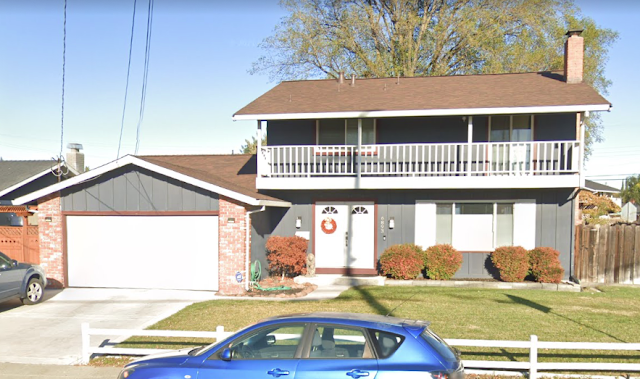
If the arch became the defining detail of late-1960s tract homes, the Monterey balcony may have been its two-story counterpart. Throughout the 1960s, builders across the Tri-Valley embraced Monterey-inspired designs in subdivisions from Dublin to San Ramon. Cantilevered second-story balconies, stucco exteriors, and symmetrical two-story façades began appearing across rapidly expanding suburban neighborhoods. The style traced its roots back to California’s earlier Monterey Revival movement, but by the postwar era, production builders had simplified and adapted its most recognizable features—stucco walls, low-pitched roofs, and projecting second-story balconies—for large-scale tract development. And for a brief period during the 1960s, the Monterey style became one of the most recognizable two-story forms in Tri-Valley suburbia. Monterey style homes across the Tri-Valley Dublin: an early leader in Monterey style Dublin was one of the first Tri-Valley communities to feature Monterey...

The great arch craze: Neo-Mediterranean tract homes in the Tri-Valley

Image
If you start driving through 1960s and 1970s neighborhoods in the Tri-Valley, eventually you notice something: arches are everywhere. Not just one or two. Entire subdivisions are filled with them. Arched entryways. Arched porches. Triple arches. Giant dramatic arches framing the garage. Tiny decorative arches that exist for no structural reason whatsoever. By the late 1960s, the arch had become one of the defining visual signatures of California tract housing. Builders across Pleasanton, Livermore, Dublin, and San Ramon embraced a suburban reinterpretation of Mediterranean and Spanish Revival architecture—what’s now called Neo-Mediterranean design. Nowhere did the style spread more enthusiastically than the Tri-Valley. Neo-Mediterranean design emerged as a simplified suburban reinterpretation of earlier Spanish Revival and Mediterranean Revival styles. Production builders borrowed the most recognizable visual elements—arches, stucco, tile roofs, and wrought iron details—an...